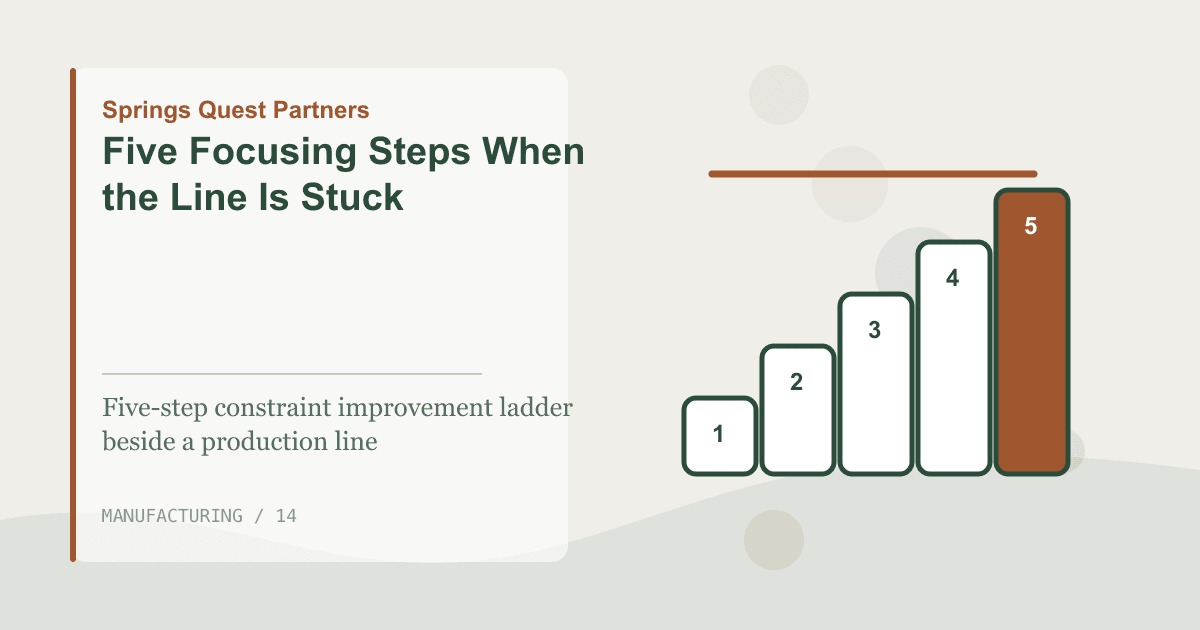
The line is stuck: WIP everywhere, due dates slipping, overtime rising. You do not need another kaizen event on a non-bottleneck. You need a loop. In The Goal (Goldratt & Cox, 1984), Jonah gives Alex Rogo five focusing steps: continuous improvement anchored on the constraint.
This is Lesson 5 in our series. The prior lessons gave you measurements, flow, bottleneck management, and the balanced-plant fallacy. This lesson turns them into a repeatable process.
#1. Identify the constraint
Look for the biggest WIP piles and the resource that sets ship rate. A bottleneck is any resource with capacity less than or equal to demand placed on it. Name it on the whiteboard so every shift, planner, and supervisor argues about the same operation.
If you cannot agree on one constraint, pick the dominant one: the operation whose downtime most directly caps shipped orders this month. You can refine later.
Tip. If WIP piles point at one operation and your ERP says a different one is "critical," trust the piles. ERP routing rarely captures real-time queue dynamics.
#2. Exploit the constraint
Squeeze waste out of constraint time before spending capital:
- No idle lunches on the constraint when safe and staffed
- QC upstream of the constraint; scrap after the bottleneck is unrecoverable throughput
- Only process parts needed for current orders
- Eliminate setup and changeover waste at the constraint first
An hour lost at the constraint is an hour lost for the plant. Exploit is where most quick wins live, and where most plants still leave money on the table while they debate capital requests.
Scrap after the bottleneck is unrecoverable throughput. Redesign inspection placement before buying faster machines.
#3. Subordinate everything else
Release material at the bottleneck's consumption rate. Non-bottlenecks may look "underutilized." That is correct. Feeding them to avoid idle time rebuilds the WIP swamp described in the local efficiency trap and the balanced plant illusion.
Subordinate means every other function (planning, engineering, sales promising, maintenance scheduling) aligns to protect and feed the constraint. It is the hardest step because it requires saying no to local heroics.
Rate your site honestly on a 1–5 scale: How well does planning subordinate to the constraint? Weak subordinate is the usual lie.
#4. Elevate the constraint
If exploit and subordinate are not enough, add capacity: redeploy old equipment, outsource selected operations, adjust engineering to bypass the constraint where quality allows. Alex's moves (reviving retired machines and sending parts to outside heat-treat) are classic elevate without a capital freeze.
Elevate is step four, not step one. Buying capacity before fixing release policy rebuilds the swamp faster. Compare vendor and capital options at system margin, not unit cost at one operation.
When production outruns demand, marketing and product mix become step one. Inertia keeps building WIP nobody will buy.
#5. Repeat and fight inertia
When the constraint breaks, return to step one. Do not keep red-tag rituals, finished-goods buffers, or batch-size rules built for the old bottleneck. Inertia turns yesterday's fix into today's choke point.
Post the five-step loop in the constraint area. Every improvement idea must name which step it serves, or it waits.
#Run the loop this month
Pick one product family. Map WIP by operation. Protect one constraint hour daily for two weeks. Measure throughput, inventory, and expense, not utilization alone.
#Step audit worksheet
Rate honest 1–5 on exploit and subordinate for each constraint. Weak subordinate is the usual lie. Most sites score high on identify (they know the bottleneck) and low on subordinate (they still release to keep upstream busy).
| Step | Honest question | Common failure mode |
|---|---|---|
| Identify | Do we agree on one constraint? | Debating while WIP grows |
| Exploit | Is constraint time fully protected? | Lunch, setup, waiting on material |
| Subordinate | Does release match consumption? | Flooding upstream to hit utilization |
| Elevate | Did we exhaust exploit/subordinate first? | Capital before policy |
| Repeat | Did we audit old rules when constraint moved? | Inertia preserves dead policies |
#Inertia audit: policies to review when the constraint moves
When throughput jumps after a constraint break, audit these policies within two weeks:
| Policy | Inertia risk | Question to ask |
|---|---|---|
| Batch sizes | Old constraint favored large batches | Does current constraint need smaller batches? |
| Red/green tags | Built for previous bottleneck | Does expediting still protect the new constraint? |
| FG buffer targets | Sized for old ship rate | Does buffer hide a new market constraint? |
| Overtime rules | Written for old bottleneck op | Does overtime still land at the constraint? |
| Safety stock levels | Set when supplier was the constraint | Does inventory now exceed consumption rate? |
Skipping the inertia audit is how plants "do TOC" for six months and revert to local efficiency within a year.
#Market as constraint
When production outruns demand, the constraint is not inside the plant. It is the market. Building WIP nobody will buy violates the productivity test: inventory rises, throughput does not.
Signs the market is your constraint:
- Finished goods grow while open orders flatline
- Sales discounts increase to move product already built
- Production hits monthly targets while revenue misses plan
Step one in that environment is not "run faster." It is align product mix, release rate, and commercial promises to what customers will actually buy this month.
#Running the loop with your CI team
Most CI programs spread kaizen across the line. TOC concentrates it on the constraint. Use the five steps as your kaizen filter:
| CI idea | Step it serves | Gate question |
|---|---|---|
| Setup reduction at constraint | Exploit | Does it recover constraint hours? |
| Release schedule change | Subordinate | Does it match consumption rate? |
| Outsource heat-treat | Elevate | Did exploit/subordinate fail first? |
| New CNC at upstream op | None | Does it feed or flood the constraint? |
Ideas that fail the gate wait. This discipline prevents the most common TOC failure mode: improving everything except the constraint.
#Two-week pilot template
Run this pilot on one product family before plant-wide rollout:
Week 1: Identify and exploit
- Name the constraint on a whiteboard
- Map WIP by operation for this family
- Protect one constraint hour daily (no idle lunch, QC before, material ready)
- Measure: shipped orders, WIP at constraint, constraint downtime reasons
Week 2: Subordinate
- Set daily release limit = constraint consumption rate
- Stop overtime at non-constraints unless constraint is fed
- Measure: total WIP trend, lead time for pilot family, overtime by operation
Debrief with leads using the three measurements. If throughput rose or WIP fell, you have proof for the next family.
#Communicating the loop to leadership
Plant managers who run the five steps need one slide for leadership, not forty. Structure it as:
- Constraint named: [operation]
- Exploit actions taken: [list with hours recovered]
- Subordinate change: [release rate before → after]
- Results (two weeks): throughput, inventory, expense trend
- Next step: exploit more / elevate / repeat at new constraint
Leadership does not need TOC theory. They need proof that the loop beats another capital request without policy change.
Tip. Photograph WIP at the constraint before and after subordinate. One image often earns more trust than a spreadsheet.
#Training supervisors
Non-bottleneck leads must celebrate flow, not local busy scores. Retrain metrics before retrain people. A supervisor whose bonus depends on uptime will fight subordinate every time.
#Quality at the constraint
Scrap after the bottleneck is unrecoverable throughput. Redesign inspection placement before buying faster machines. One bad part that consumes constraint time costs the whole plant an hour, not one operation's scrap budget.
#Vendor elevate
Outside capacity is elevate, not failure. Cost compare at system margin, not unit cost at one operation. Lead time and due-date reliability belong in the same spreadsheet as piece price.
#Whiteboard the five steps
Post the loop in the constraint area. Every improvement idea must name which step it serves, or it waits. This single discipline prevents kaizen tourism on non-bottlenecks.
Our FAQ for busy plant leaders answers pushback you will hear in production meetings. The TOC operator cheat sheet closes the series with a printable reference.
← Start the series · ← Balanced Plant · Next: FAQ →
#Related guides
Sources
- Goldratt, E. M., & Cox, J. (1984). The Goal: A Process of Ongoing Improvement. North River Press.
Operational education for plant leaders, not legal, financial, or engineering advice for your site. Adapt metrics and safety rules to your policies.