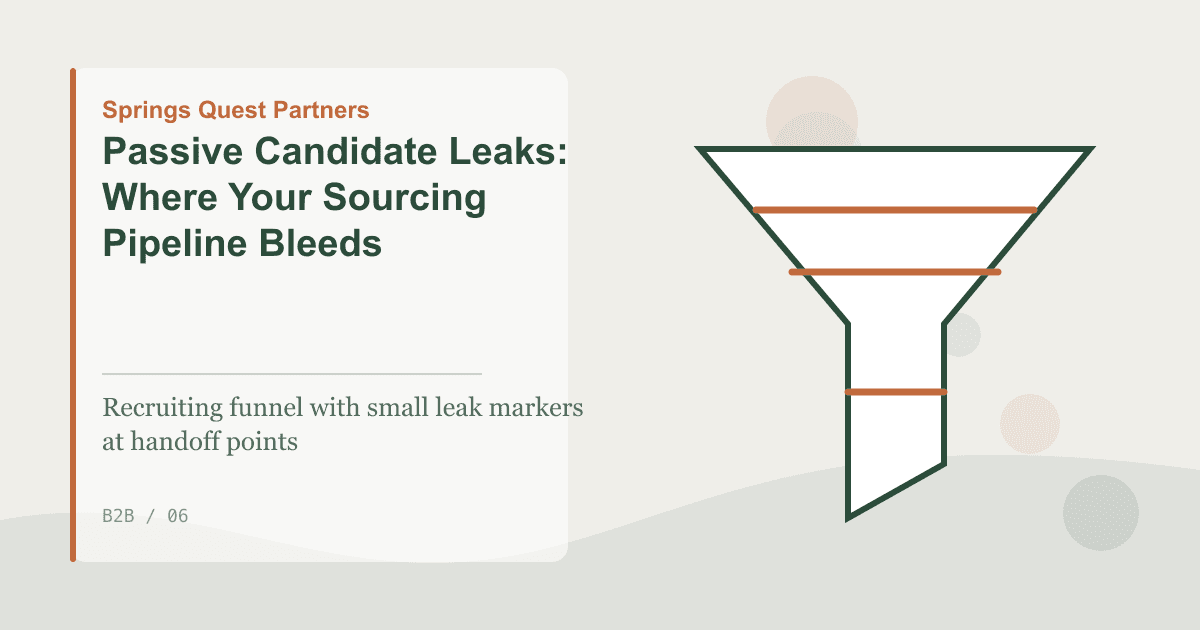
Your sourcer spent two weeks on a passive director candidate. The recruiter rewrites the summary. The hiring manager never opens the profile. Six weeks later the candidate accepts elsewhere. You did not lose on comp. You lost on handoff.
Passive talent leaks happen between systems and between owners. Fixing leaks is cheaper than raising bands for candidates who never saw a structured process. The engine in own your sourcing engine only works if profiles, context, and SLAs survive the trip from sourcer to panel.
You can increase outreach volume and still lose more passive candidates if handoffs drop context. Leaks are measurable: hours and days between sourced, HM review, interview scheduling, and debrief. Ops discipline on those gaps often beats comp adjustments that never get presented because the profile never reached the decision-maker.
#One owner per requisition
Split ownership (sourcer finds, recruiter "owns relationship," hiring manager decides) without a single accountable DRI and you get dropped context every time. Assign one owner with SLA: profile to HM review within forty-eight hours. If HM misses SLA, pause the req until capacity is real or downgrade priority.
Handoff template should be paste-in, not Slack-only:
- Sourcing story (how you found them, what resonated)
- Objections heard and how you answered
- Comp band discussed with alignment to HM
- Next touch date and owner
- HM-specific hook proving you read their work
Track time from sourced → HM review → interview → debrief. Leaks show up as long gaps between stages, not as mysterious "market" excuses.
Tip. Block HM interview hours when the requisition opens. Passive candidates cool fast when scheduling drags two weeks.
#CRM rediscovery and disciplined outreach
Silver-medalists from prior searches already passed bar once. Run rediscovery queries before burning InMail on strangers. Tag outcomes: withdrew, comp mismatch, timing, culture miss, so the next search starts informed instead of repeating the same dead ends.
Passive candidates need sequences across roughly twenty-one days (value, role clarity, proof you read their work), not a generic blast. Track touches in the ATS, not personal inboxes. First message should reference article, talk, repo, or shipped work, not flattery templates.
Compensation clarity early: passive candidates disengage when bands surface late. Align sourcer and HM on band before outreach so mid-process surprises do not waste relationship capital.
#Same bar for referrals and agencies
Employee referrals need criteria, not "know anyone?" Same ICP, same objective hiring rubrics, same divergence-first debrief, or referrals become nepotism risk and calibration debt.
When using agencies, define who owns the CRM record and who owns the relationship post-submit. Duplicated outreach kills passive trust. Agency submits should land in the same handoff template and SLAs as internal sourcers.
When the candidate interviews, interviewers score independently before meeting. Open on disagreement anchored to quotes, not rank or tenure. That protects quality and creates audit trail for downstream calibration.
#Measure leaks and tighten the system
SLA metrics worth a weekly ops review:
- Sourced → HM review (target forty-eight hours)
- HM review → first interview scheduled
- Interview → debrief with complete score entry
- Offer → accept (teams often target above 80% when process is tight)
Brand in outreach matters: passive talent compares you to employers who run structured, respectful processes. Pair leak fixes with governance when spend and compliance scale (see governance for high-growth SMBs).
Build the full engine in own your sourcing engine once handoffs are tight. Engines fail when the best candidates never reach the structured panel.
#Operational checklist for passive pipelines
- Single DRI named on the req with escalation when SLA missed
- Handoff template fields required in ATS before HM notification
- Comp band aligned between sourcer and HM before first outreach
- CRM tags on silver-medalists updated after every closed search
- Sequence steps scheduled across ~21 days, not single blast
- HM interview blocks on calendar at req open
- Forty-eight-hour HM profile review SLA enforced or req paused
- Referral and agency paths use same ICP and rubric as internal sourcers
- Weekly ops review publishes sourced→HM→interview gap times
Passive loss is rarely mysterious market tightness. It is measurable wait time between stages. Fix wait time before raising bands.
When debriefs finally happen, run them with objective hiring rubrics: independent scores, divergence-first discussion, quotes, not rank. Passive candidates who endured your process deserve the same bar as active applicants; otherwise you leak reputation, not just pipeline.
#What to do this week
- Map one recent passive loss end-to-end. Where did days accumulate?
- Implement the handoff template in ATS notes for the next three profiles.
- Run CRM rediscovery for one open role before new cold search.
- Enforce HM forty-eight-hour review SLA or pause the req.
- Audit referral and agency paths for the same rubric and score submission rules.
#Ops review agenda (weekly, fifteen minutes)
Review median hours between sourced → HM review → interview scheduled → debrief complete. Assign one fix owner per longest gap. Pause reqs when HM misses forty-eight-hour review twice. Capacity planning beats blaming sourcers. Share wins when handoff templates shorten time-to-interview; positive proof trains the org faster than policy memos.
Closing the loop: when a passive candidate declines, capture why in CRM tags: timing, comp, role scope, process fatigue. When they accept, trace which touches and handoff steps correlated with win. Passive pipelines compound when loss reasons are data, not hallway stories. Keep the weekly fifteen-minute ops review even when reqs are slow so discipline does not reset before the next surge.
#Related guides
Sources
- SHRM. Talent acquisition resources: industry context on passive sourcing and pipeline leakage.
This article is operational education only, not legal advice. Work with qualified counsel for compliance, compensation, and termination decisions in your jurisdiction.